

Urinary incontinence can become more common with age, but that doesn’t mean leakage should be accepted as an unavoidable part of getting older.
For an older person, the cause of urinary leakage can differ from person to person. Pelvic-floor muscle weakness may be involved, but so can urinary infections, medication, constipation, mobility problems, neurological conditions, bladder problems or prostate-related issues in men.
That makes the first question less about age and more about what is causing the symptoms.
Some forms of urinary incontinence can improve substantially with appropriate treatment. In other cases, the aim may be better symptom control rather than complete resolution. The right approach depends on the type of incontinence, the underlying cause and the person’s overall health.
Comparing Treatment Options for Incontinence in Older Adults
| Approach | How It Is Delivered | Where It May Fit | Practical Considerations | Important Limitations |
|---|---|---|---|---|
| EMS (Electromagnetic Seat) | Chair-based electromagnetic pelvic-floor stimulation while seated and clothed. | An option to discuss for people interested in electromagnetic pelvic-floor stimulation. | Requires little active physical movement during the session. | Research is still developing, and evidence from one electromagnetic system or treatment protocol should not automatically be applied to another. |
| Supervised Pelvic-Floor Muscle Training | A structured programme of pelvic-floor muscle contractions guided by a suitably trained healthcare professional. | First-line treatment for women with stress or mixed urinary incontinence. | Requires regular participation and the ability to perform the exercises correctly. | Some people may need additional help to identify or contract the pelvic-floor muscles correctly. |
| Bladder Training | A structured approach that gradually increases the interval between feeling the need to urinate and using the toilet. | Particularly relevant to urgency or mixed urinary incontinence. | Requires regular practice as part of a longer-term routine. | It is not designed to address every cause or type of urinary incontinence. |
| Lifestyle and Fluid Management | Changes may include reviewing caffeine intake, fluid intake and other factors that can aggravate urinary symptoms. | Can form part of conservative management depending on the person’s symptoms. | Usually incorporated into everyday routines rather than delivered as a procedure. | Changes should be appropriate to the individual; deliberately restricting fluids is not a universal solution. |
| Medication | Prescription treatment selected according to the type of urinary symptoms and the person’s medical circumstances. | May be considered for some forms of urinary symptoms when conservative measures are insufficient or unsuitable. | Requires consideration of existing medicines, other conditions and possible side effects. | Medication is not appropriate for every type of incontinence and should be selected by a healthcare professional. |
| Containment Products | Absorbent pads, collecting devices or other continence products selected according to individual needs. | Can provide practical management while the cause of urinary symptoms is being assessed or treated. | Availability, fit, comfort and changing requirements vary between individuals. | These products manage leakage but do not treat the underlying cause of urinary incontinence. |
| Specialist or Surgical Treatment | May involve specialist procedures or surgery when appropriate for the diagnosed type and cause of incontinence. | Considered for selected patients when other approaches have not provided sufficient benefit or are not appropriate. | Requires specialist assessment and, where relevant, preparation and recovery. | Suitability depends on the diagnosis, overall health, previous treatment and the risks and benefits of the procedure. |
| Note: Treatment options are not interchangeable. The most appropriate approach depends on the type of urinary incontinence, its possible cause, the person’s health and individual circumstances. A healthcare professional can help determine which options are appropriate. | ||||
Understanding Incontinence in Older Adults Wolverhampton
Urinary incontinence means involuntary leakage of urine. It is not a single condition, and the symptoms can take several forms.
Stress urinary incontinence: This happens when urine leaks during common activities that increase pressure on the bladder, such as coughing, sneezing, lifting or exercising.
Urgency urinary incontinence: This involves a sudden need to urinate followed by leakage. It is commonly associated with overactive bladder symptoms.
Overflow incontinence can occur when the bladder does not empty properly and urine leaks as it becomes overfilled.
Functional incontinence is different. The bladder may not be the main problem; a person may struggle to reach the toilet because of limited mobility, cognitive impairment or another physical difficulty.
Some people have mixed urinary incontinence, where more than one type of leakage occurs.
This distinction matters because a treatment that works for one type of incontinence may not work for another.
What Can Cause Incontinence in Older Adults?
Age can increase the likelihood of urinary symptoms, but it does not identify the cause on its own.
Several factors may contribute.
Pelvic-Floor Muscle Changes
The pelvic-floor muscles help support the bladder and urethra and contribute to continence. Reduced muscle strength or difficulty contracting these muscles can contribute to urinary leakage.
This is particularly relevant when someone has stress urinary incontinence.
Urinary Tract Infections
A urinary tract infection can really cause urinary symptoms, including urgency and frequency, and may be accompanied by leakage.
New urinary symptoms should therefore not automatically be assumed to be age-related weakness.
Medication
Some medicines can affect urinary frequency or bladder function. Diuretics, for example, increase urine production.
For an older person taking several medicines, reviewing the medication history with a healthcare professional can be an important part of understanding the problem.
Mobility and Physical Limitations
Someone may recognise the need to use the toilet but still struggle to get there in time because of arthritis, reduced mobility, balance problems or another physical limitation.
In that situation, treating the pelvic floor alone may not address the main difficulty.
Neurological Conditions
Conditions affecting the nervous system can alter bladder storage and emptying. Parkinson’s disease, multiple sclerosis, stroke and other neurological conditions can be associated with lower urinary tract symptoms.
When a neurological condition is present, consider bladder symptoms in the wider clinical context.
Prostate and Bladder Problems in Men
Older men may experience urinary symptoms related to prostate enlargement or other lower urinary tract problems.
NICE recommends assessing possible causes, medical conditions and medication when men present with lower urinary tract symptoms rather than assuming that the symptoms have one simple explanation.
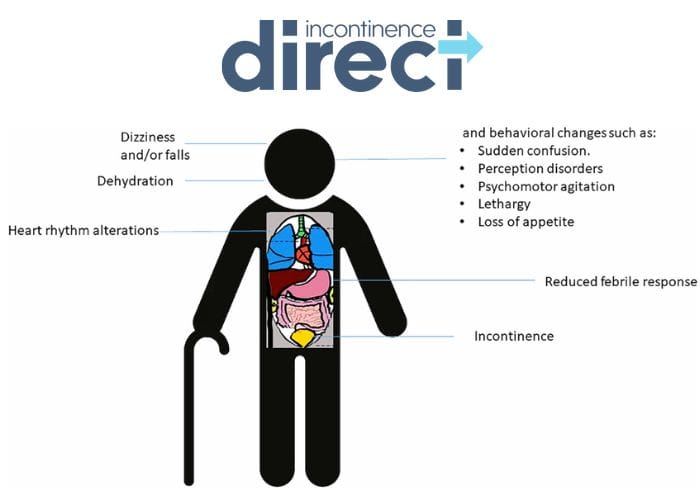
Treatment Options for Incontinence in Older Adults Wolverhampton
No single treatment works for every type of urinary incontinence. Start by identifying the symptoms and, where appropriate, the underlying cause.
1. Lifestyle Measures
Depending on the symptoms, a healthcare professional may recommend changes such as reducing caffeine, reviewing fluid intake or addressing other lifestyle factors.
Drinking too much fluid can increase urinary frequency, but deliberately drinking too little can also cause problems. Fluid changes should therefore be sensible, not extreme.
2. Pelvic-Floor Muscle Training
Pelvic-floor muscle training is an established treatment for urinary incontinence.
For women with stress or mixed urinary incontinence, NICE recommends a supervised pelvic-floor muscle training programme lasting at least three months.
For men with stress urinary incontinence following prostatectomy, NICE also recommends supervised pelvic-floor muscle training before moving to other options.
The key point is that pelvic-floor training should match the person’s symptoms and ability to contract the correct muscles.
3. Bladder Training
Bladder training may be recommended for urgency urinary incontinence or overactive bladder symptoms.
The aim is to gradually increase the time between feeling the urge to urinate and actually passing urine.
NICE recommends bladder training for at least six weeks as a first-line treatment for women with urgency or mixed urinary incontinence.
4. Medicines
Medicines may be appropriate for some forms of urinary incontinence or associated bladder symptoms.
The choice depends on the diagnosis, other health conditions and existing medication. This is particularly important in older adults, where multiple medicines and other medical conditions may affect treatment decisions.
5. Other Treatment options
Depending on the type of incontinence and the individual’s circumstances, healthcare professionals may also consider devices, specialist continence care or surgery.
These options are not interchangeable, and some apply only to particular diagnoses.
Know More About EMS Chair Here.
Can Incontinence in Older Adults Be Cured?
Sometimes, but there is no blanket answer.
If you can identify and treat the underlying or root cause, urinary leakage may improve substantially and, in some cases, resolve.
For others, particularly when several factors contribute to the symptoms, complete resolution may not be realistic. Treatment can still make a meaningful difference by reducing leakage, urgency or frequency and making day-to-day activities easier.
A 2025 Cochrane network meta-analysis examined treatments for urinary incontinence in women aged 60 and over. Physical therapies, particularly pelvic-floor muscle training, performed well in the analysis, but the authors also highlighted limitations in the available evidence and said there was not enough certainty to identify one best treatment overall.
That is a useful distinction: improvement is possible for many people, but “curable” should not be used as a promise.
Improving Quality of Life
Urinary leakage can affect much more than bladder control.
Some older adults become reluctant to leave home, exercise, travel, or attend social events because they worry about finding a toilet or having an accident.
Practical consequences can also include disturbed sleep, changes to daily routines, and reliance on absorbent products.
Addressing the underlying urinary problem, where possible, can therefore support independence and participation while reducing leakage.
If mobility or cognitive difficulties contribute to the problem, include those factors in the management plan rather than treating bladder symptoms in isolation.
How Our EMS (Electromagnetic Seat) Treatment Fits In: Direct Incontinence Wolverhampton
Incontinence Direct Wolverhampton provides a private mobile service using electromagnetic pelvic-floor stimulation.
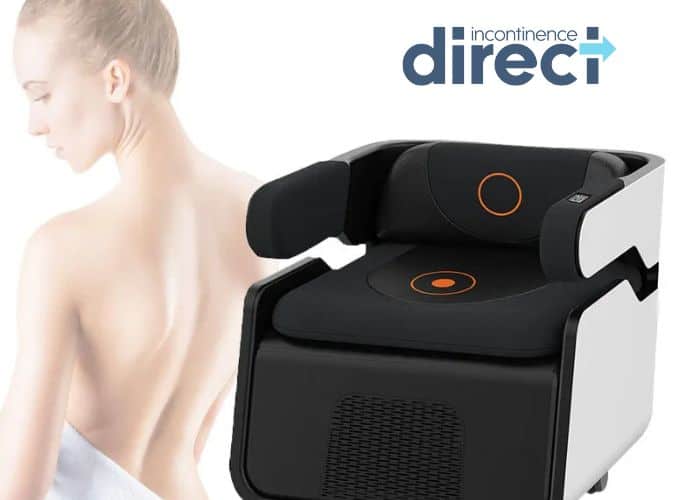
The chair-based treatment is delivered while the customer remains seated and clothed. The equipment is intended to produce repeated pelvic-floor muscle contractions through electromagnetic stimulation.
There is an important distinction here.
Research into electromagnetic pelvic-floor stimulation has reported improvements in some urinary incontinence outcomes, but research on a particular electromagnetic technology or device should not automatically be treated as evidence for every other system.
There is also no basis for saying that an EMS chair is appropriate for every older adult with urinary incontinence.
For someone whose symptoms have not been medically assessed, identifying the type and likely cause of the incontinence should come first.
What Is EMS (Electromagnetic Seat) Treatment?
EMS treatment uses electromagnetic stimulation delivered through a chair-based system.
The person remains seated during the session rather than performing each pelvic-floor contraction voluntarily.
This differs from conventional pelvic-floor muscle training, where the individual actively contracts and relaxes the pelvic-floor muscles.
It is also important not to treat all forms of electrical or electromagnetic stimulation as the same intervention. Different technologies use different methods, and evidence must match the treatment being discussed.
How Does EMS Work?
The chair delivers electromagnetic stimulation intended to produce repeated contractions of the pelvic-floor muscles.
Those contractions are the reason electromagnetic stimulation has been investigated as a possible approach to pelvic-floor rehabilitation and urinary incontinence.
However, the fact that a treatment produces muscle contractions does not by itself establish that it will correct the underlying cause of an individual’s urinary leakage.
Available research also uses specific equipment, treatment protocols, and patient groups. Those details matter when interpreting the findings.
What Are the Potential Benefits of EMS (Electromagnetic Seat) Treatment?

The main practical feature of a chair-based EMS service is that pelvic-floor stimulation can be delivered while the person remains seated and clothed.
For someone considering this type of treatment, other potential advantages may include the fact that it does not involve an internal probe or surgery.
However, it would be misleading to describe EMS as a guaranteed treatment for urinary incontinence or to promise a particular number of sessions, a specific degree of improvement or how long any improvement will last.
Research into electromagnetic stimulation is still developing, and outcomes can vary between studies and individuals.
EMS should therefore be considered as one option to discuss, rather than a replacement for appropriate assessment or established treatment such as supervised pelvic-floor muscle training.
Contact us for more information on the EMS Chair, and find out whether it Suits Your Circumstances.
Frequently Asked Questions: Incontinence in Adults, Symptoms, Options for Safe Treatments
Can incontinence issues in older adults be cured?
No single cure applies to all older adults. Sometimes urinary incontinence can resolve when a root cause is identified and treated. In other cases, treatment focuses on reducing symptoms. This also improves day-to-day control.
Can pelvic-floor exercises help older adults?
Yes. Pelvic-floor muscle training is an established treatment for urinary incontinence. NICE recommends supervised pelvic-floor muscle training as a first-line treatment for women with stress or even mixed urinary incontinence.
Can medication cause urinary incontinence?
Some medicines can change bladder function and may affect how often you need to urinate. If you notice a change after starting a medicine or changing the dose, tell your doctor or another healthcare professional. If your doctor prescribed the medicine, keep taking it as directed unless your doctor tells you otherwise.
Is EMS the same as pelvic-floor muscle training?
No. Pelvic-floor muscle training involves voluntarily contracting the pelvic-floor muscles. EMS uses electromagnetic stimulation to produce muscle contractions through the treatment equipment.
When should an older adult seek medical advice about incontinence?
Medical advice is appropriate when symptoms are new, changing or troublesome, particularly where there is pain, blood in the urine, difficulty emptying the bladder, recurrent urinary infections, significant mobility changes or neurological symptoms.
Is incontinence a normal part of ageing?
No. Urinary incontinence becomes more common with age, but leakage should not simply be dismissed as an inevitable consequence of getting older. Healthcare professionals can often investigate and manage the underlying cause.
What if an older person has difficulty doing pelvic-floor exercises?
A healthcare professional can assess whether the person can contract the pelvic-floor muscles correctly and whether they need additional support.
For people with neurological conditions, mobility problems or cognitive impairment, the management approach may need to be adapted to their individual circumstances.
Can an EMS chair help older adults with incontinence?
Electromagnetic pelvic-floor stimulation has been studied for urinary incontinence, but the evidence does not show that every EMS system produces the same results. It should not be presented as a guaranteed treatment for older adults.
Is EMS suitable for everyone over a certain age?
No. Age alone cannot determine suitability. The person’s symptoms, medical history, mobility, medications and the type of urinary problem all need to be considered.
How long does an EMS session take?
The Incontinence Direct service uses a chair-based session while the customer remains seated and clothed. Confirm the appropriate session length and treatment schedule with the service, rather than assuming a research protocol for another device applies.
Take Control of Your Bladder Health
Urinary incontinence in later life deserves proper assessment, not being written off as something that simply comes with ageing.
The right treatment depends on the type of leakage and what is contributing to it. For some people, pelvic-floor muscle training, bladder training, lifestyle changes or treatment of an underlying or root condition can make a substantial difference.
Electromagnetic pelvic-floor stimulation is another treatment approach being studied for urinary incontinence. Incontinence Direct provides this as a private mobile service for people who want to explore the option.
If you are considering EMS, a sensible starting point is understanding your symptoms and whether the service is appropriate for your circumstances.
Sources & Further Reading
NHS — Urinary incontinence
NHS — Non-surgical treatment for urinary incontinence
NICE — Urinary incontinence and pelvic organ prolapse in women: management (NG123)
NICE — Lower urinary tract symptoms in men: management (CG97)
PubMed — Interventions for treating urinary incontinence in older women: a network meta-analysis
Medical Information Notice
This article provides general information about urinary incontinence and is not a diagnosis or substitute for advice from a GP or other qualified healthcare professional.
Urinary symptoms in older adults can have different causes. Published research relates to specific populations, interventions and treatment protocols and should not be interpreted as a guarantee of outcome from Incontinence Direct.
Consider individual suitability for any treatment before proceeding.
Last Reviewed: September 2026 by Incontinence Direct Editorial Team Wolverhampton